Start21 Prep › Einbürgerungstest
Einbürgerungstest: Deutschland in Europa
20 Fragen aus dem amtlichen Fragenkatalog zum Thema „Deutschland in Europa“ (Germany in Europe). Die richtige Antwort ist grün markiert. Darunter stehen eine kurze Erklärung und die englische Übersetzung. Zum Online-Test
1. Deutschland ist Mitglied des Schengener Abkommens. Was bedeutet das?
Germany is a member of the Schengen Agreement. What does that mean?
- Deutsche können in viele Länder Europas ohne Passkontrolle reisen. · Germans can travel to many European countries without passport checks.
- Alle Menschen können ohne Personenkontrolle in Deutschland einreisen. · Everyone can enter Germany without identity checks.
- Deutsche können ohne Passkontrolle in jedes Land reisen. · Germans can travel to any country without passport checks.
- Deutsche können in jedem Land mit dem Euro bezahlen. · Germans can pay with the euro in every country.
Erklärung: Im Schengen-Raum gibt es normalerweise keine Passkontrollen an den Binnengrenzen.
In the Schengen area there are normally no passport checks at the internal borders.
2. Welches Land ist ein Nachbarland von Deutschland?
Which country is a neighbouring country of Germany?
- Ungarn · Hungary
- Portugal · Portugal
- Spanien · Spain
- Schweiz · Switzerland
Erklärung: Deutschland hat neun Nachbarländer: Dänemark, Polen, Tschechien, Österreich, die Schweiz, Frankreich, Luxemburg, Belgien und die Niederlande.
Germany has nine neighbours: Denmark, Poland, the Czech Republic, Austria, Switzerland, France, Luxembourg, Belgium and the Netherlands.
3. Welches Land ist ein Nachbarland von Deutschland?
Which country is a neighbouring country of Germany?
- Rumänien · Romania
- Bulgarien · Bulgaria
- Polen · Poland
- Griechenland · Greece
Erklärung: Polen grenzt im Osten an Deutschland.
Poland borders Germany to the east.
4. Was bedeutet die Abkürzung EU?
What does the abbreviation EU stand for?
- Europäische Unternehmen · European Enterprises
- Europäische Union · European Union
- Einheitliche Union · Unified Union
- Euro Union · Euro Union
Erklärung: EU ist die Abkürzung für Europäische Union.
EU stands for European Union.
5. In welchem anderen Land gibt es eine große deutschsprachige Bevölkerung?
In which other country is there a large German-speaking population?
- Tschechien · Czech Republic
- Norwegen · Norway
- Spanien · Spain
- Österreich · Austria
Erklärung: In Österreich ist Deutsch Amtssprache. Fast alle Menschen dort sprechen Deutsch.
German is the official language in Austria, and almost everyone there speaks German.
6. Welche ist die Flagge der Europäischen Union?
Which is the flag of the European Union?
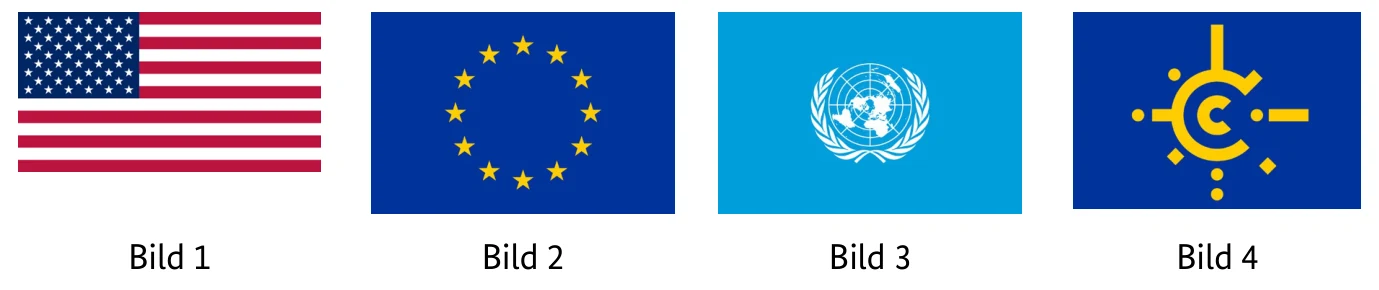
- Bild 1 · Picture 1
- Bild 2 · Picture 2
- Bild 3 · Picture 3
- Bild 4 · Picture 4
Erklärung: Die Flagge der EU zeigt einen Kreis aus zwölf goldenen Sternen auf blauem Grund. Das ist Bild 2.
The EU flag shows a circle of twelve gold stars on a blue background. That is picture 2.
7. Welches Land ist ein Nachbarland von Deutschland?
Which country is a neighbouring country of Germany?
- Finnland · Finland
- Dänemark · Denmark
- Norwegen · Norway
- Schweden · Sweden
Erklärung: Dänemark grenzt im Norden an Deutschland.
Denmark borders Germany to the north.
8. Wie wird der Beitritt der DDR zur Bundesrepublik Deutschland im Jahr 1990 allgemein genannt?
What is the GDR's accession to the Federal Republic of Germany in 1990 generally called?
- NATO-Osterweiterung · NATO eastward enlargement
- EU-Osterweiterung · EU eastward enlargement
- Deutsche Wiedervereinigung · German reunification
- Europäische Gemeinschaft · European Community
Erklärung: Den Beitritt der DDR zur Bundesrepublik am 3. Oktober 1990 nennt man Deutsche Wiedervereinigung.
The GDR's accession to the Federal Republic on 3 October 1990 is called German reunification.
9. Welches Land ist ein Nachbarland von Deutschland?
Which country is a neighbouring country of Germany?
- Spanien · Spain
- Bulgarien · Bulgaria
- Norwegen · Norway
- Luxemburg · Luxembourg
Erklärung: Luxemburg grenzt im Westen an Deutschland.
Luxembourg borders Germany to the west.
10. Das Europäische Parlament wird regelmäßig gewählt, nämlich alle …
The European Parliament is elected regularly, namely every …
- 5 Jahre. · 5 years.
- 6 Jahre. · 6 years.
- 7 Jahre. · 7 years.
- 8 Jahre. · 8 years.
Erklärung: Das Europäische Parlament wird alle 5 Jahre gewählt.
The European Parliament is elected every 5 years.
11. Was bedeutet der Begriff "europäische Integration"?
What does the term "European integration" mean?
- Damit sind amerikanische Einwanderinnen und Einwanderer in Europa gemeint. · It refers to American immigrants in Europe.
- Der Begriff meint den Einwanderungsstopp nach Europa. · It means stopping immigration to Europe.
- Damit sind europäische Auswanderinnen und Auswanderer in den USA gemeint. · It refers to European emigrants in the USA.
- Der Begriff meint den Zusammenschluss europäischer Staaten zur EU. · It means the joining together of European states to form the EU.
Erklärung: Europäische Integration heißt: Europäische Staaten schließen sich enger zusammen, heute in der EU.
European integration means European countries joining together more closely, today in the EU.
12. Wer wird bei der Europawahl gewählt?
Who is elected in the European election?
- die Europäische Kommission · the European Commission
- die Länder, die in die EU eintreten dürfen · the countries allowed to join the EU
- die Abgeordneten des Europäischen Parlaments · the members of the European Parliament
- die europäische Verfassung · the European constitution
Erklärung: Bei der Europawahl wählen die Bürgerinnen und Bürger der EU die Abgeordneten des Europäischen Parlaments.
In the European elections, EU citizens elect the members of the European Parliament.
13. Welches Land ist ein Nachbarland von Deutschland?
Which country is a neighbouring country of Germany?
- Tschechien · Czech Republic
- Bulgarien · Bulgaria
- Griechenland · Greece
- Portugal · Portugal
Erklärung: Tschechien grenzt im Südosten an Deutschland.
The Czech Republic borders Germany to the south-east.
14. Wo ist ein Sitz des Europäischen Parlaments?
Where is one seat of the European Parliament?
- London · London
- Paris · Paris
- Berlin · Berlin
- Straßburg · Strasbourg
Erklärung: Der offizielle Sitz des Europäischen Parlaments ist Straßburg. Dort finden die meisten Plenarsitzungen statt.
The official seat of the European Parliament is Strasbourg, where most plenary sessions take place.
15. Der damalige französische Staatspräsident François Mitterrand und der damalige deutsche Bundeskanzler Helmut Kohl gedenken in Verdun gemeinsam der Toten beider Weltkriege. Welches Ziel der Europäischen Union wird bei diesem Treffen deutlich?
The then French President François Mitterrand and the then German Chancellor Helmut Kohl together commemorate the dead of both world wars in Verdun. Which goal of the European Union does this meeting make clear?
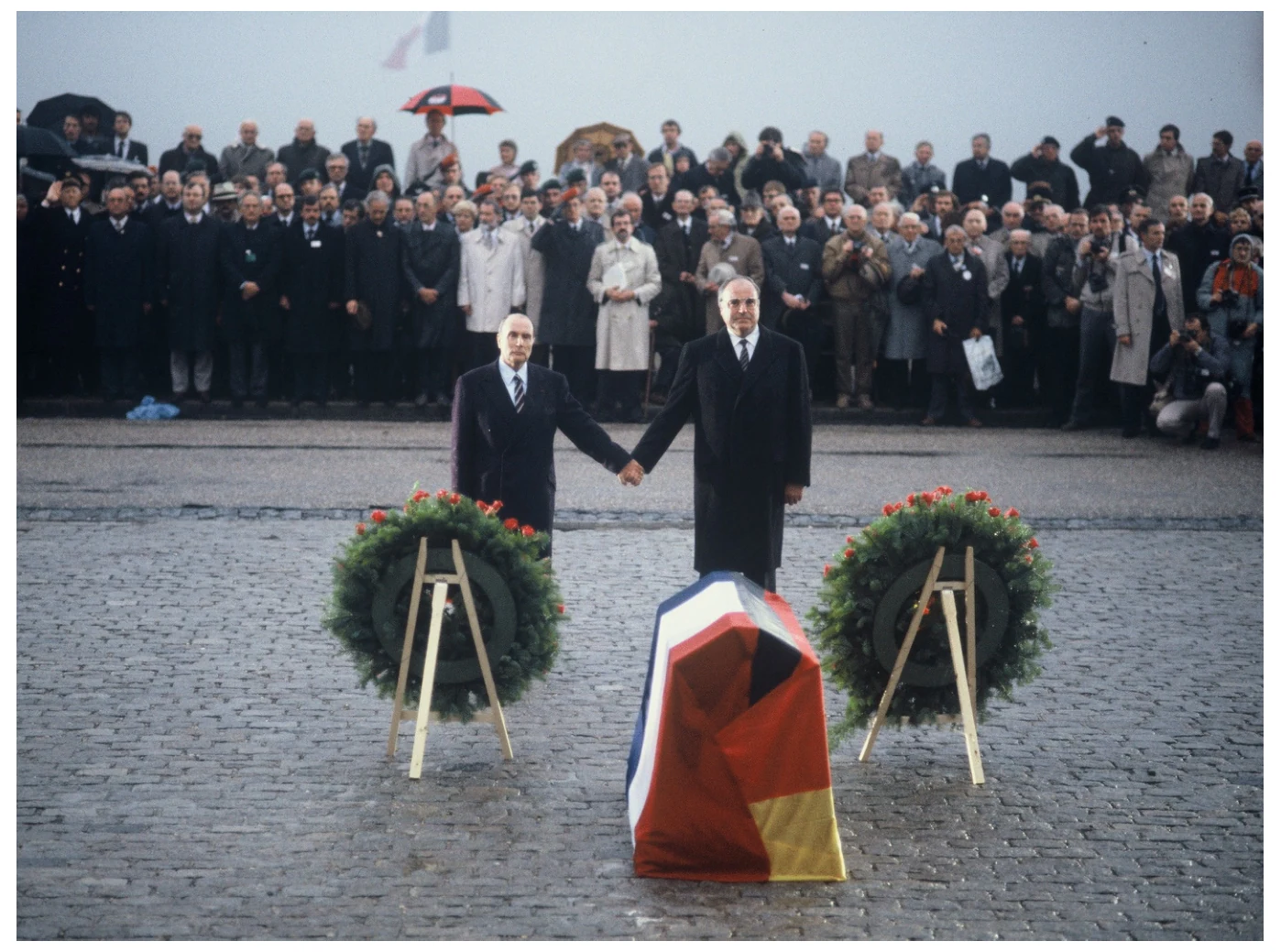
© Bundesregierung/Richard Schulze-Vorberg
- Freundschaft zwischen England und Deutschland · friendship between England and Germany
- Reisefreiheit in alle Länder der EU · freedom to travel to all EU countries
- Frieden und Sicherheit in den Ländern der EU · peace and security in the EU countries
- einheitliche Feiertage in den Ländern der EU · the same public holidays in the EU countries
Erklärung: Kohl und Mitterrand gedachten 1984 Hand in Hand in Verdun der Kriegstoten. Das zeigt das Ziel der EU: Frieden und Sicherheit zwischen ihren Ländern.
In 1984 Kohl and Mitterrand stood hand in hand at Verdun to remember the war dead. This shows the EU's aim: peace and security between its countries.
16. Wie viele Mitgliedstaaten hat die EU heute?
How many member states does the EU have today?
- 21 · 21
- 23 · 23
- 25 · 25
- 27 · 27
Erklärung: Die EU hat 27 Mitgliedstaaten (seit dem Austritt Großbritanniens 2020).
The EU has 27 member states (since the United Kingdom left in 2020).
17. 2007 wurde das 50-jährige Jubiläum der "Römischen Verträge" gefeiert. Was war der Inhalt der Verträge?
In 2007, the 50th anniversary of the "Treaties of Rome" was celebrated. What did the treaties contain?
- Beitritt Deutschlands zur NATO · Germany joining NATO
- Gründung der Europäischen Wirtschaftsgemeinschaft (EWG) · the founding of the European Economic Community (EEC)
- Verpflichtung Deutschlands zu Reparationsleistungen · Germany's obligation to pay reparations
- Festlegung der Oder-Neiße-Linie als Ostgrenze · fixing the Oder-Neisse line as the eastern border
Erklärung: Mit den Römischen Verträgen wurde 1957 die Europäische Wirtschaftsgemeinschaft (EWG) gegründet.
The Treaties of Rome founded the European Economic Community (EEC) in 1957.
18. An welchen Orten arbeitet das Europäische Parlament?
In which places does the European Parliament work?
- Paris, London und Den Haag · Paris, London and The Hague
- Straßburg, Luxemburg und Brüssel · Strasbourg, Luxembourg and Brussels
- Rom, Bern und Wien · Rome, Bern and Vienna
- Bonn, Zürich und Mailand · Bonn, Zurich and Milan
Erklärung: Das Europäische Parlament tagt in Straßburg und Brüssel. Ein Teil der Verwaltung sitzt in Luxemburg.
The European Parliament meets in Strasbourg and Brussels, and part of its administration is in Luxembourg.
19. Durch welche Verträge schloss sich die Bundesrepublik Deutschland mit anderen Staaten zur Europäischen Wirtschaftsgemeinschaft zusammen?
Through which treaties did the Federal Republic of Germany join other states to form the European Economic Community?
- durch die "Hamburger Verträge" · the "Treaties of Hamburg"
- durch die "Römischen Verträge" · the "Treaties of Rome"
- durch die "Pariser Verträge" · the "Treaties of Paris"
- durch die "Londoner Verträge" · the "Treaties of London"
Erklärung: Durch die Römischen Verträge von 1957 gründete die Bundesrepublik mit fünf Staaten die EWG.
Through the Treaties of Rome of 1957, the Federal Republic and five other states founded the EEC.
20. Seit wann bezahlt man in Deutschland mit dem Euro in bar?
Since when have people in Germany paid in cash with the euro?
- 1995 · 1995
- 1998 · 1998
- 2002 · 2002
- 2005 · 2005
Erklärung: Euro-Münzen und -Scheine gibt es seit dem 1. Januar 2002. Als Buchgeld gab es den Euro schon ab 1999.
Euro coins and notes have existed since 1 January 2002. As a non-cash currency the euro already existed from 1999.