Start21 Prep › Einbürgerungstest
Einbürgerungstest: Staat & Föderalismus
49 Fragen aus dem amtlichen Fragenkatalog zum Thema „Staat & Föderalismus“ (State & federalism). Die richtige Antwort ist grün markiert. Darunter stehen eine kurze Erklärung und die englische Übersetzung. Zum Online-Test
1. Welches ist das Wappen der Bundesrepublik Deutschland?
Which is the coat of arms of the Federal Republic of Germany?
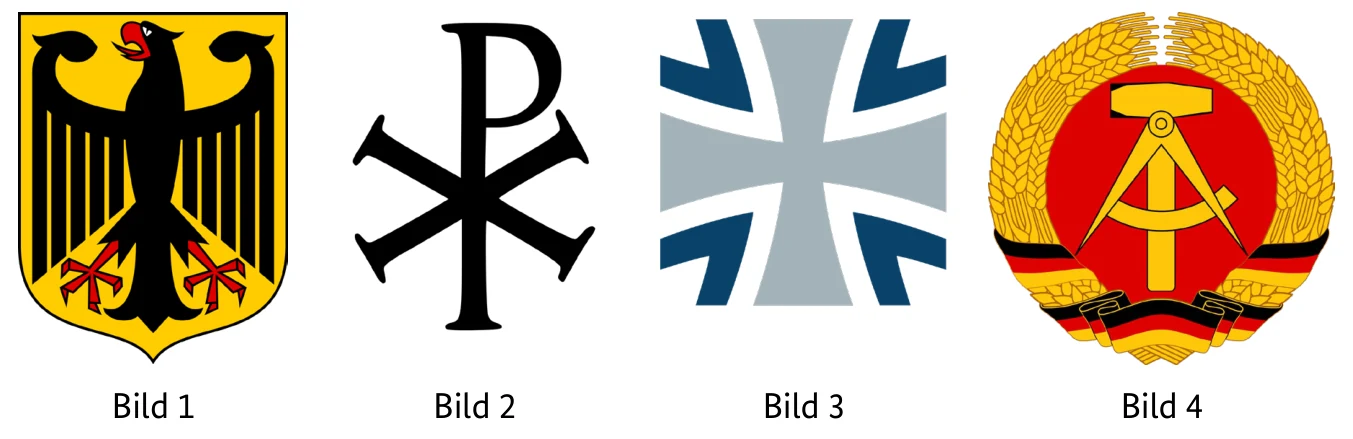
- Bild 1 · Picture 1
- Bild 2 · Picture 2
- Bild 3 · Picture 3
- Bild 4 · Picture 4
Erklärung: Das Bundeswappen zeigt einen schwarzen Adler mit roten Krallen und rotem Schnabel auf goldenem Grund. Das ist Bild 1.
The federal coat of arms shows a black eagle with red claws and a red beak on a gold background. That is picture 1.
2. Was für eine Staatsform hat Deutschland?
What form of state does Germany have?
- Monarchie · monarchy
- Diktatur · dictatorship
- Republik · republic
- Fürstentum · principality
Erklärung: Deutschland ist eine Republik: Das Staatsoberhaupt wird gewählt, es gibt keinen König.
Germany is a republic: the head of state is elected and there is no monarch.
3. In Deutschland sind die meisten Erwerbstätigen …
In Germany, most working people …
- in kleinen Familienunternehmen beschäftigt. · work in small family businesses.
- ehrenamtlich für ein Bundesland tätig. · work as volunteers for a federal state.
- selbstständig mit einer eigenen Firma tätig. · are self-employed with their own company.
- bei einer Firma oder Behörde beschäftigt. · are employed by a company or a public authority.
Erklärung: Die meisten Erwerbstätigen in Deutschland sind Arbeitnehmerinnen und Arbeitnehmer, also bei einer Firma oder Behörde angestellt.
Most people in work in Germany are employees, working for a company or a public authority.
4. Wie viele Bundesländer hat die Bundesrepublik Deutschland?
How many federal states (Bundesländer) does the Federal Republic of Germany have?
- 14 · 14
- 15 · 15
- 16 · 16
- 17 · 17
Erklärung: Deutschland besteht aus 16 Bundesländern.
Germany consists of 16 federal states.
5. Was ist kein Bundesland der Bundesrepublik Deutschland?
Which of these is not a federal state of the Federal Republic of Germany?
- Elsass-Lothringen · Alsace-Lorraine
- Nordrhein-Westfalen · North Rhine-Westphalia
- Mecklenburg-Vorpommern · Mecklenburg-Western Pomerania
- Sachsen-Anhalt · Saxony-Anhalt
Erklärung: Elsass-Lothringen ist eine Region in Frankreich und kein deutsches Bundesland.
Alsace-Lorraine is a region in France, not a German federal state.
6. Deutschland ist …
Germany is …
- eine kommunistische Republik. · a communist republic.
- ein demokratischer und sozialer Bundesstaat. · a democratic and social federal state.
- eine kapitalistische und soziale Monarchie. · a capitalist and social monarchy.
- ein sozialer und sozialistischer Bundesstaat. · a social and socialist federal state.
Erklärung: Das Grundgesetz sagt: Die Bundesrepublik Deutschland ist ein demokratischer und sozialer Bundesstaat.
The Basic Law states that the Federal Republic of Germany is a democratic and social federal state.
7. Deutschland ist …
Germany is …
- ein sozialistischer Staat. · a socialist state.
- ein Bundesstaat. · a federal state.
- eine Diktatur. · a dictatorship.
- eine Monarchie. · a monarchy.
Erklärung: Deutschland ist ein Bundesstaat: Der Bund und die 16 Länder haben jeweils eigene staatliche Aufgaben.
Germany is a federal state: the federation and the 16 states each have their own state powers.
8. Wer wählt in Deutschland die Abgeordneten zum Bundestag?
Who elects the members of the Bundestag in Germany?
- das Militär · the military
- die Wirtschaft · business
- das wahlberechtigte Volk · the people entitled to vote
- die Verwaltung · the administration
Erklärung: Die Abgeordneten des Bundestages werden vom Volk in allgemeiner, unmittelbarer, freier, gleicher und geheimer Wahl gewählt.
Members of the Bundestag are elected by the people in general, direct, free, equal and secret elections.
9. Welches Tier ist das Wappentier der Bundesrepublik Deutschland?
Which animal is the heraldic animal of the Federal Republic of Germany?
- Löwe · lion
- Adler · eagle
- Bär · bear
- Pferd · horse
Erklärung: Das Wappentier Deutschlands ist der Adler, der „Bundesadler“.
Germany's heraldic animal is the eagle, the "federal eagle".
10. Was ist kein Merkmal unserer Demokratie?
What is not a feature of our democracy?
- regelmäßige Wahlen · regular elections
- Pressezensur · press censorship
- Meinungsfreiheit · freedom of opinion
- verschiedene Parteien · different parties
Erklärung: In der Demokratie ist die Presse frei. Das Grundgesetz sagt: „Eine Zensur findet nicht statt.“
In a democracy the press is free. The Basic Law says: "There shall be no censorship."
11. Die Zusammenarbeit von Parteien zur Bildung einer Regierung nennt man in Deutschland …
In Germany, cooperation between parties to form a government is called …
- Einheit. · unity.
- Koalition. · a coalition.
- Ministerium. · a ministry.
- Fraktion. · a parliamentary group.
Erklärung: Wenn sich mehrere Parteien zusammentun, um gemeinsam zu regieren, nennt man das Koalition.
When several parties join forces to govern together, this is called a coalition.
12. Was ist keine staatliche Gewalt in Deutschland?
What is not a branch of state power in Germany?
- Gesetzgebung · legislation
- Regierung · government
- Presse · the press
- Rechtsprechung · the judiciary
Erklärung: Die drei staatlichen Gewalten sind Gesetzgebung, vollziehende Gewalt und Rechtsprechung. Die Presse ist frei und gehört nicht zum Staat.
The three powers of the state are the legislature, the executive and the judiciary. The press is free and not part of the state.
13. Welche Aussage ist richtig? In Deutschland …
Which statement is correct? In Germany …
- sind Staat und Religionsgemeinschaften voneinander getrennt. · the state and religious communities are separate from each other.
- bilden die Religionsgemeinschaften den Staat. · the religious communities form the state.
- ist der Staat abhängig von den Religionsgemeinschaften. · the state depends on the religious communities.
- bilden Staat und Religionsgemeinschaften eine Einheit. · the state and religious communities form a single unit.
Erklärung: In Deutschland gibt es keine Staatskirche. Staat und Religionsgemeinschaften sind getrennt.
There is no state church in Germany. The state and religious communities are separate.
14. Was ist Deutschland nicht?
What is Germany not?
- eine Demokratie · a democracy
- ein Rechtsstaat · a state under the rule of law
- eine Monarchie · a monarchy
- ein Sozialstaat · a welfare state
Erklärung: Deutschland ist eine Republik mit gewähltem Staatsoberhaupt, keine Monarchie.
Germany is a republic with an elected head of state, not a monarchy.
15. Womit finanziert der deutsche Staat die Sozialversicherung?
How does the German state finance social insurance?
- Kirchensteuer · church tax
- Sozialabgaben · social security contributions
- Spendengeldern · donations
- Vereinsbeiträgen · club membership fees
Erklärung: Die Sozialversicherung wird vor allem aus den Beiträgen (Sozialabgaben) von Beschäftigten und Arbeitgebern bezahlt.
Social insurance is funded mainly by the contributions (social security contributions) of employees and employers.
16. Welche Maßnahme schafft in Deutschland soziale Sicherheit?
Which measure creates social security in Germany?
- die Krankenversicherung · health insurance
- die Autoversicherung · car insurance
- die Gebäudeversicherung · buildings insurance
- die Haftpflichtversicherung · liability insurance
Erklärung: Die Krankenversicherung ist Teil der Sozialversicherung und schützt bei Krankheit. Sie ist in Deutschland Pflicht.
Health insurance is part of social insurance and protects you when you are ill. It is compulsory in Germany.
17. Wie werden die Regierungschefinnen/Regierungschefs der meisten Bundesländer in Deutschland genannt?
What are the heads of government of most German federal states called?
- Erste Ministerin/Erster Minister · First Minister
- Premierministerin/Premierminister · Prime Minister
- Senatorin/Senator · Senator
- Ministerpräsidentin/Ministerpräsident · Minister-President
Erklärung: In den Flächenländern heißt die Regierungschefin/der Regierungschef Ministerpräsidentin/Ministerpräsident. In den Stadtstaaten heißt das Amt anders (z. B. Bürgermeister).
In the territorial states the head of government is called Minister-President. In the city-states the title is different (e.g. mayor).
18. Die Bundesrepublik Deutschland ist ein demokratischer und sozialer …
The Federal Republic of Germany is a democratic and social …
- Staatenverbund. · union of states.
- Bundesstaat. · federal state.
- Staatenbund. · confederation of states.
- Zentralstaat. · centralised state.
Erklärung: Das Grundgesetz nennt Deutschland einen „demokratischen und sozialen Bundesstaat“.
The Basic Law calls Germany a "democratic and social federal state".
19. Was hat jedes deutsche Bundesland?
What does every German federal state have?
- eine eigene Außenministerin/einen eigenen Außenminister · its own foreign minister
- eine eigene Währung · its own currency
- eine eigene Armee · its own army
- eine eigene Regierung · its own government
Erklärung: Jedes Bundesland hat eine eigene Verfassung, ein eigenes Parlament und eine eigene Regierung.
Each federal state has its own constitution, parliament and government.
20. Mit welchen Worten beginnt die deutsche Nationalhymne?
With which words does the German national anthem begin?
- Völker, hört die Signale … · "Völker, hört die Signale …"
- Einigkeit und Recht und Freiheit … · "Einigkeit und Recht und Freiheit …"
- Freude schöner Götterfunken … · "Freude schöner Götterfunken …"
- Deutschland einig Vaterland … · "Deutschland einig Vaterland …"
Erklärung: Die Nationalhymne ist die dritte Strophe des „Lieds der Deutschen“. Sie beginnt mit „Einigkeit und Recht und Freiheit“.
The national anthem is the third verse of the "Song of the Germans". It begins with "Unity and justice and freedom".
21. Warum gibt es in einer Demokratie mehr als eine Partei?
Why is there more than one party in a democracy?
- weil dadurch die unterschiedlichen Meinungen der Bürgerinnen und Bürger vertreten werden · because this way the different opinions of citizens are represented
- damit Bestechung in der Politik begrenzt wird · so that bribery in politics is limited
- um politische Demonstrationen zu verhindern · to prevent political demonstrations
- um wirtschaftlichen Wettbewerb anzuregen · to stimulate economic competition
Erklärung: Mehrere Parteien bilden die verschiedenen Meinungen in der Gesellschaft ab. Parteien wirken bei der politischen Willensbildung mit.
Several parties reflect the different opinions in society. Parties help to shape the political will of the people.
22. Wer beschließt in Deutschland ein neues Gesetz?
Who passes a new law in Germany?
- die Regierung · the government
- das Parlament · the parliament
- die Gerichte · the courts
- die Polizei · the police
Erklärung: Gesetze beschließt das Parlament. Bundesgesetze beschließt der Bundestag, der Bundesrat wirkt mit.
Laws are passed by parliament. Federal laws are passed by the Bundestag, with the participation of the Bundesrat.
23. Wann kann in Deutschland eine Partei verboten werden?
When can a party be banned in Germany?
- wenn ihr Wahlkampf zu teuer ist · if its election campaign is too expensive
- wenn sie gegen die Verfassung kämpft · if it fights against the constitution
- wenn sie Kritik am Staatsoberhaupt äußert · if it criticises the head of state
- wenn ihr Programm eine neue Richtung vorschlägt · if its programme proposes a new direction
Erklärung: Eine Partei, die die freiheitliche demokratische Grundordnung bekämpft, kann vom Bundesverfassungsgericht verboten werden.
A party that fights against the free democratic basic order can be banned by the Federal Constitutional Court.
24. Wen kann man als Bürgerin/Bürger in Deutschland nicht direkt wählen?
Whom can citizens in Germany not elect directly?
- Abgeordnete des EU-Parlaments · members of the European Parliament
- Die Bundespräsidentin/den Bundespräsidenten · the Federal President
- Landtagsabgeordnete · members of a state parliament
- Bundestagsabgeordnete · members of the Bundestag
Erklärung: Die Bundespräsidentin/den Bundespräsidenten wählt die Bundesversammlung, nicht das Volk direkt.
The Federal President is elected by the Federal Convention, not directly by the people.
25. Zu welcher Versicherung gehört die Pflegeversicherung?
Which insurance does long-term care insurance (Pflegeversicherung) belong to?
- Sozialversicherung · social insurance
- Unfallversicherung · accident insurance
- Hausratsversicherung · household contents insurance
- Haftpflicht- und Feuerversicherung · liability and fire insurance
Erklärung: Die Pflegeversicherung (seit 1995) ist ein Zweig der gesetzlichen Sozialversicherung.
Long-term care insurance (since 1995) is a branch of statutory social insurance.
26. Der deutsche Staat hat viele Aufgaben. Welche Aufgabe gehört dazu?
The German state has many tasks. Which task is one of them?
- Er baut Straßen und Schulen. · It builds roads and schools.
- Er verkauft Lebensmittel und Kleidung. · It sells food and clothing.
- Er versorgt alle Einwohnerinnen und Einwohner kostenlos mit Zeitungen. · It supplies all residents with free newspapers.
- Er produziert Autos und Busse. · It produces cars and buses.
Erklärung: Der Staat sorgt für die öffentliche Infrastruktur, zum Beispiel Straßen und Schulen.
The state provides public infrastructure, for example roads and schools.
27. Der deutsche Staat hat viele Aufgaben. Welche Aufgabe gehört nicht dazu?
The German state has many tasks. Which task is not one of them?
- Er bezahlt für alle Staatsangehörigen Urlaubsreisen. · It pays for holidays for all its citizens.
- Er zahlt Kindergeld. · It pays child benefit.
- Er unterstützt Museen. · It supports museums.
- Er fördert Sportlerinnen und Sportler. · It supports athletes.
Erklärung: Urlaubsreisen bezahlt jede Person selbst. Das ist keine Aufgabe des Staates.
Everyone pays for their own holidays. That is not a task of the state.
28. Welches Organ gehört nicht zu den Verfassungsorganen Deutschlands?
Which body is not one of Germany's constitutional bodies?
- der Bundesrat · the Bundesrat
- die Bundespräsidentin/der Bundespräsident · the Federal President
- die Bürgerversammlung · the citizens' assembly
- die Regierung · the government
Erklärung: Verfassungsorgane sind z. B. Bundestag, Bundesrat, Bundesregierung, Bundespräsident, Bundesversammlung und Bundesverfassungsgericht. Eine „Bürgerversammlung“ gehört nicht dazu.
Constitutional bodies include the Bundestag, Bundesrat, federal government, Federal President, Federal Convention and Federal Constitutional Court. A "citizens' assembly" is not one of them.
29. Wer bestimmt in Deutschland die Schulpolitik?
Who determines school policy in Germany?
- die Lehrer und Lehrerinnen · the teachers
- die Bundesländer · the federal states
- das Familienministerium · the Ministry for Family Affairs
- die Universitäten · the universities
Erklärung: Bildung und Schule sind Sache der Länder (Kulturhoheit der Länder).
Education and schools are a matter for the federal states (the states' cultural sovereignty).
30. Die Wirtschaftsform in Deutschland nennt man …
The economic system in Germany is called …
- freie Zentralwirtschaft. · free central economy.
- soziale Marktwirtschaft. · social market economy.
- gelenkte Zentralwirtschaft. · controlled central economy.
- Planwirtschaft. · planned economy.
Erklärung: Deutschland hat eine soziale Marktwirtschaft: freier Markt mit sozialem Ausgleich durch den Staat.
Germany has a social market economy: a free market combined with social balance provided by the state.
31. Zu einem demokratischen Rechtsstaat gehört es nicht, dass …
A democratic state under the rule of law does not include …
- Menschen sich kritisch über die Regierung äußern können. · people being able to criticise the government.
- Bürger friedlich demonstrieren gehen dürfen. · citizens being allowed to demonstrate peacefully.
- Menschen von einer Privatpolizei ohne Grund verhaftet werden. · people being arrested by a private police force without reason.
- jemand ein Verbrechen begeht und deshalb verhaftet wird. · someone being arrested because they committed a crime.
Erklärung: Im Rechtsstaat darf nur der Staat nach Gesetz und mit richterlicher Kontrolle jemanden festnehmen, nie eine private Polizei ohne Grund.
Under the rule of law, only the state may detain someone, based on law and under a judge's control, never a private police force without reason.
32. Was bedeutet "Volkssouveränität"? Alle Staatsgewalt geht vom ...
What does "sovereignty of the people" (Volkssouveränität) mean? All state power comes from …
- Volke aus. · the people.
- Bundestag aus. · the Bundestag.
- preußischen König aus. · the Prussian king.
- Bundesverfassungsgericht aus. · the Federal Constitutional Court.
Erklärung: Volkssouveränität bedeutet: „Alle Staatsgewalt geht vom Volke aus.“
Popular sovereignty means: "All state authority is derived from the people."
33. Was bedeutet "Rechtsstaat" in Deutschland?
What does "Rechtsstaat" (rule of law) mean in Germany?
- Der Staat hat Recht. · The state is always right.
- Es gibt nur rechte Parteien. · There are only right-wing parties.
- Die Bürgerinnen und Bürger entscheiden über Gesetze. · Citizens decide on laws.
- Der Staat muss die Gesetze einhalten. · The state must obey the laws.
Erklärung: Rechtsstaat heißt: Auch der Staat muss sich an Recht und Gesetz halten.
The rule of law means the state itself must obey the law.
34. Was ist keine staatliche Gewalt in Deutschland?
What is not a branch of state power in Germany?
- Legislative · legislature
- Judikative · judiciary
- Exekutive · executive
- Direktive · directive
Erklärung: Die drei staatlichen Gewalten heißen Legislative, Exekutive und Judikative. „Direktive“ ist keine Staatsgewalt.
The three powers of the state are the legislature, the executive and the judiciary. A "directive" is not a power of the state.
35. Was zeigt dieses Bild?
What does this picture show?
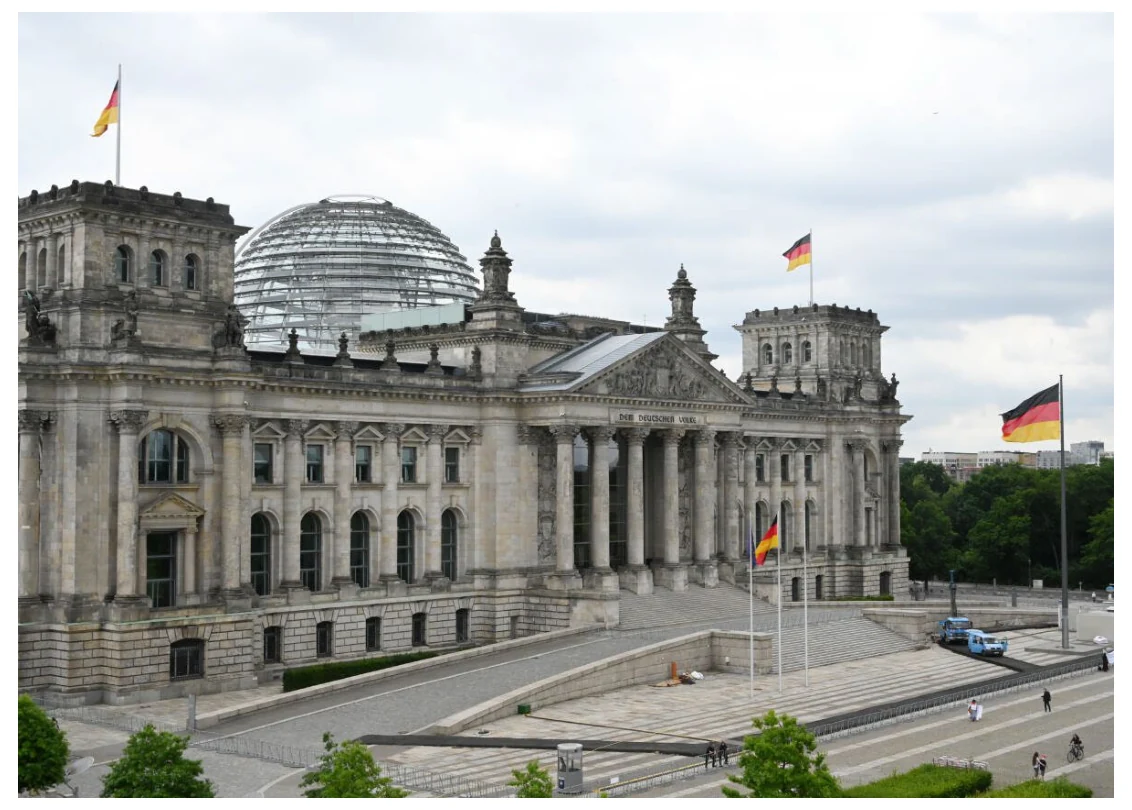
© Deutscher Bundestag/Achim Melde
- den Bundestagssitz in Berlin · the seat of the Bundestag in Berlin
- das Bundesverfassungsgericht in Karlsruhe · the Federal Constitutional Court in Karlsruhe
- das Bundesratsgebäude in Berlin · the Bundesrat building in Berlin
- das Bundeskanzleramt in Berlin · the Federal Chancellery in Berlin
Erklärung: Das Bild zeigt das Reichstagsgebäude in Berlin. Dort hat der Deutsche Bundestag seit 1999 seinen Sitz.
The picture shows the Reichstag building in Berlin, where the German Bundestag has met since 1999.
36. Welches Amt gehört in Deutschland zur Gemeindeverwaltung?
Which office belongs to the municipal administration in Germany?
- Pfarramt · parish office
- Ordnungsamt · public order office
- Finanzamt · tax office
- Auswärtiges Amt · Federal Foreign Office
Erklärung: Das Ordnungsamt gehört zur Verwaltung der Stadt oder Gemeinde. Es sorgt z. B. für öffentliche Sicherheit und Ordnung.
The public order office is part of the town or municipal administration. It takes care of public safety and order, for example.
37. Wer wird meistens zur Präsidentin/zum Präsidenten des Deutschen Bundestages gewählt?
Who is usually elected President of the German Bundestag?
- die/der älteste Abgeordnete im Parlament · the oldest member of parliament
- die Ministerpräsidentin/der Ministerpräsident des größten Bundeslandes · the Minister-President of the largest federal state
- eine ehemalige Bundeskanzlerin/ein ehemaliger Bundeskanzler · a former Federal Chancellor
- eine Abgeordnete/ein Abgeordneter der stärksten Fraktion · a member of the largest parliamentary group
Erklärung: Nach parlamentarischem Brauch kommt die Bundestagspräsidentin/der Bundestagspräsident aus der stärksten Fraktion.
By parliamentary custom, the President of the Bundestag comes from the largest parliamentary group.
38. Wer ernennt in Deutschland die Ministerinnen/die Minister der Bundesregierung?
Who appoints the federal ministers in Germany?
- die Präsidentin/der Präsident des Bundesverfassungsgerichtes · the President of the Federal Constitutional Court
- die Bundespräsidentin/der Bundespräsident · the Federal President
- die Bundesratspräsidentin/der Bundesratspräsident · the President of the Bundesrat
- die Bundestagspräsidentin/der Bundestagspräsident · the President of the Bundestag
Erklärung: Die Bundesministerinnen und Bundesminister werden auf Vorschlag der Bundeskanzlerin/des Bundeskanzlers von der Bundespräsidentin/dem Bundespräsidenten ernannt.
Federal ministers are appointed by the Federal President on the proposal of the Federal Chancellor.
39. Vor wie vielen Jahren gab es erstmals eine jüdische Gemeinde auf dem Gebiet des heutigen Deutschlands?
How many years ago was there a Jewish community on the territory of today's Germany for the first time?
- vor etwa 300 Jahren · about 300 years ago
- vor etwa 700 Jahren · about 700 years ago
- vor etwa 1150 Jahren · about 1,150 years ago
- vor etwa 1700 Jahren · about 1,700 years ago
Erklärung: Ein Erlass von Kaiser Konstantin aus dem Jahr 321 belegt eine jüdische Gemeinde in Köln. Das ist etwa 1700 Jahre her.
A decree by Emperor Constantine from the year 321 records a Jewish community in Cologne, about 1700 years ago.
40. In Deutschland gehören der Bundestag und der Bundesrat zur …
In Germany, the Bundestag and the Bundesrat belong to the …
- Exekutive. · executive.
- Legislative. · legislature.
- Direktive. · directive.
- Judikative. · judiciary.
Erklärung: Bundestag und Bundesrat beschließen die Bundesgesetze. Sie gehören damit zur gesetzgebenden Gewalt, der Legislative.
The Bundestag and Bundesrat pass federal laws, so they belong to the law-making power, the legislature.
41. Was bedeutet "Volkssouveränität"?
What does "sovereignty of the people" (Volkssouveränität) mean?
- Die Königin/der König herrscht über das Volk. · The queen/king rules over the people.
- Das Bundesverfassungsgericht steht über der Verfassung. · The Federal Constitutional Court stands above the constitution.
- Die Interessenverbände üben die Souveränität zusammen mit der Regierung aus. · Interest groups exercise sovereignty together with the government.
- Die Staatsgewalt geht vom Volke aus. · State power comes from the people.
Erklärung: Volkssouveränität bedeutet, dass alle Staatsgewalt vom Volk ausgeht, z. B. durch Wahlen.
Popular sovereignty means that all state authority comes from the people, for example through elections.
42. Wenn das Parlament eines deutschen Bundeslandes gewählt wird, nennt man das …
When the parliament of a German federal state is elected, this is called …
- Kommunalwahl · a local election
- Landtagswahl · a state election
- Europawahl · a European election
- Bundestagswahl · a federal election
Erklärung: Das Parlament eines Bundeslandes heißt meist Landtag. Seine Wahl heißt Landtagswahl.
The parliament of a federal state is usually called the Landtag, and its election is a Landtag (state) election.
43. Was gehört in Deutschland nicht zur Exekutive?
What does not belong to the executive in Germany?
- die Polizei · the police
- die Gerichte · the courts
- das Finanzamt · the tax office
- die Ministerien · the ministries
Erklärung: Gerichte sind die Rechtsprechung (Judikative). Zur Exekutive gehören Regierung und Verwaltung, z. B. auch die Polizei.
Courts are the judiciary. The executive consists of the government and administration, including the police, for example.
44. Die Bundesrepublik Deutschland ist heute gegliedert in …
Today, the Federal Republic of Germany is divided into …
- vier Besatzungszonen. · four occupation zones.
- einen Oststaat und einen Weststaat. · an eastern state and a western state.
- 16 Kantone. · 16 cantons.
- Bund, Länder und Kommunen. · the federation, the states and the municipalities.
Erklärung: Deutschland hat drei Ebenen: den Bund, die Länder und die Kommunen (Städte, Gemeinden, Kreise).
Germany has three levels: the federation, the states and local authorities (towns, municipalities, districts).
45. Es gehört nicht zu den Aufgaben des Deutschen Bundestages, …
It is not one of the tasks of the German Bundestag …
- Gesetze zu entwerfen. · to draft laws.
- die Bundesregierung zu kontrollieren. · to scrutinise the federal government.
- die Bundeskanzlerin/den Bundeskanzler zu wählen. · to elect the Federal Chancellor.
- das Bundeskabinett zu bilden. · to form the federal cabinet.
Erklärung: Das Kabinett bildet die Bundeskanzlerin/der Bundeskanzler, die Minister ernennt der Bundespräsident. Der Bundestag beschließt Gesetze und wählt den Kanzler.
The cabinet is formed by the Chancellor, and ministers are appointed by the Federal President. The Bundestag passes laws and elects the Chancellor.
46. Welche Städte haben die größten jüdischen Gemeinden in Deutschland?
Which cities have the largest Jewish communities in Germany?
- Berlin und München · Berlin and Munich
- Hamburg und Essen · Hamburg and Essen
- Nürnberg und Stuttgart · Nuremberg and Stuttgart
- Worms und Speyer · Worms and Speyer
Erklärung: Die größten jüdischen Gemeinden in Deutschland gibt es in Berlin und München.
The largest Jewish communities in Germany are in Berlin and Munich.
47. Was ist in Deutschland vor allem eine Aufgabe der Bundesländer?
What is mainly a task of the federal states in Germany?
- Verteidigungspolitik · defence policy
- Außenpolitik · foreign policy
- Wirtschaftspolitik · economic policy
- Schulpolitik · school policy
Erklärung: Die Schulpolitik ist vor allem Aufgabe der Bundesländer. Deshalb unterscheiden sich die Schulsysteme der Länder.
School policy is mainly a task of the federal states. That is why school systems differ between the states.
48. Warum kontrolliert der Staat in Deutschland das Schulwesen?
Why does the state supervise the school system in Germany?
- weil es in Deutschland nur staatliche Schulen gibt · because there are only state schools in Germany
- weil alle Schülerinnen und Schüler einen Schulabschluss haben müssen · because all pupils must have a school-leaving qualification
- weil es in den Bundesländern verschiedene Schulen gibt · because there are different schools in the federal states
- weil es nach dem Grundgesetz seine Aufgabe ist · because it is its task under the Basic Law
Erklärung: Das Grundgesetz bestimmt: Das gesamte Schulwesen steht unter der Aufsicht des Staates.
The Basic Law states that the entire school system is under the supervision of the state.
49. Die Bundesrepublik Deutschland hat einen dreistufigen Verwaltungsaufbau. Wie heißt die unterste politische Stufe?
The Federal Republic of Germany has a three-tier administrative structure. What is the lowest political tier called?
- Stadträte · city councils
- Landräte · district administrators
- Gemeinden · municipalities
- Bezirksämter · district offices
Erklärung: Die unterste Verwaltungsstufe sind die Gemeinden (Kommunen). Sie regeln die örtlichen Angelegenheiten selbst.
The lowest level of administration is the municipalities. They manage local affairs themselves.