Start21 Prep › Einbürgerungstest
Einbürgerungstest: Teilung & Einheit
36 Fragen aus dem amtlichen Fragenkatalog zum Thema „Teilung & Einheit“ (Division & reunification). Die richtige Antwort ist grün markiert. Darunter stehen eine kurze Erklärung und die englische Übersetzung. Zum Online-Test
1. Wofür stand der Ausdruck "Eiserner Vorhang"? Für die Abschottung …
What did the term "Iron Curtain" stand for? For the sealing-off …
- des Warschauer Pakts gegen den Westen · of the Warsaw Pact from the West
- Norddeutschlands gegen Süddeutschland · of northern Germany from southern Germany
- Nazi-Deutschlands gegen die Alliierten · of Nazi Germany from the Allies
- Europas gegen die USA · of Europe from the USA
Erklärung: „Eiserner Vorhang“ war ein Bild für die Abschottung der Staaten des Ostblocks (Warschauer Pakt) gegenüber dem Westen.
"Iron Curtain" was an image for the way the Eastern bloc states (Warsaw Pact) sealed themselves off from the West.
2. Im Jahr 1953 gab es in der DDR einen Aufstand, an den lange Zeit in der Bundesrepublik Deutschland ein Feiertag erinnerte. Wann war das?
In 1953 there was an uprising in the GDR, which for a long time was commemorated by a public holiday in the Federal Republic of Germany. When was it?
- 1. Mai · 1 May
- 17. Juni · 17 June
- 20. Juli · 20 July
- 9. November · 9 November
Erklärung: Am 17. Juni 1953 gab es in der DDR einen Volksaufstand. In der Bundesrepublik war der 17. Juni bis 1990 Feiertag.
On 17 June 1953 there was a popular uprising in the GDR. In West Germany, 17 June was a public holiday until 1990.
3. Welcher deutsche Staat hatte eine schwarz-rot-goldene Flagge mit Hammer, Zirkel und Ährenkranz?
Which German state had a black-red-gold flag with a hammer, a pair of compasses and a wreath of corn?
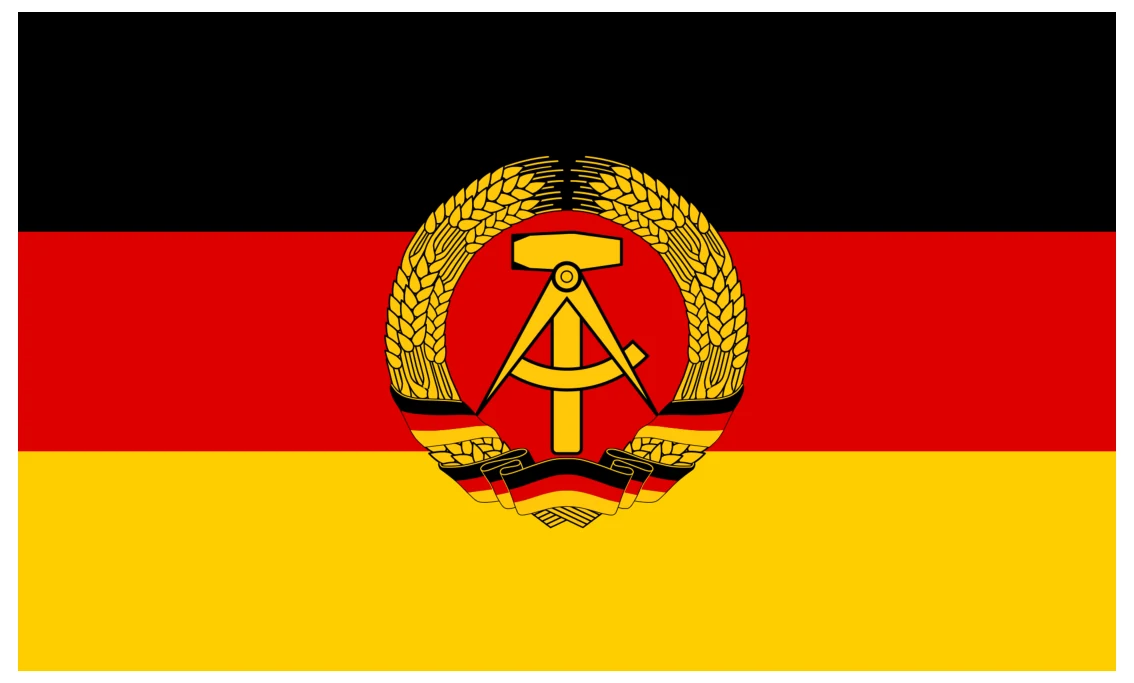
- Preußen · Prussia
- Bundesrepublik Deutschland · Federal Republic of Germany
- "Drittes Reich" · "Third Reich"
- DDR · GDR
Erklärung: Die DDR-Flagge war schwarz-rot-gold mit Hammer, Zirkel und Ährenkranz in der Mitte.
The GDR flag was black, red and gold with a hammer, compass and wreath of grain in the middle.
4. In welchem Jahr wurde die Mauer in Berlin gebaut?
In which year was the Wall in Berlin built?
- 1953 · 1953
- 1956 · 1956
- 1959 · 1959
- 1961 · 1961
Erklärung: Die Mauer wurde 1961 gebaut (ab 13. August).
The Wall was built in 1961 (from 13 August).
5. Wann baute die DDR die Mauer in Berlin?
When did the GDR build the Wall in Berlin?
- 1919 · 1919
- 1933 · 1933
- 1961 · 1961
- 1990 · 1990
Erklärung: Die DDR baute die Mauer 1961.
The GDR built the Wall in 1961.
6. Was bedeutet die Abkürzung DDR?
What does the abbreviation DDR (GDR) stand for?
- Dritter Deutscher Rundfunk · Third German Broadcasting
- Die Deutsche Republik · The German Republic
- Dritte Deutsche Republik · Third German Republic
- Deutsche Demokratische Republik · German Democratic Republic
Erklärung: DDR ist die Abkürzung für Deutsche Demokratische Republik (1949-1990).
DDR stands for German Democratic Republic (GDR, 1949-1990).
7. Wann wurde die Mauer in Berlin für alle geöffnet?
When was the Wall in Berlin opened for everyone?
- 1987 · 1987
- 1989 · 1989
- 1992 · 1992
- 1995 · 1995
Erklärung: Am 9. November 1989 wurde die Mauer geöffnet.
The Wall was opened on 9 November 1989.
8. Welches heutige deutsche Bundesland gehörte früher zum Gebiet der DDR?
Which of today's German federal states used to be part of the GDR?
- Brandenburg · Brandenburg
- Bayern · Bavaria
- Saarland · Saarland
- Hessen · Hesse
Erklärung: Brandenburg ist eines der fünf Länder, die 1990 auf dem Gebiet der DDR (neu) gegründet wurden.
Brandenburg is one of the five states (re)established in 1990 on the territory of the GDR.
9. Von 1961 bis 1989 war Berlin …
From 1961 to 1989, Berlin was …
- ohne Bürgermeister. · without a mayor.
- ein eigener Staat. · a separate state.
- durch eine Mauer geteilt. · divided by a wall.
- nur mit dem Flugzeug erreichbar. · reachable only by plane.
Erklärung: Von 1961 bis 1989 teilte die Mauer Berlin in Ost und West.
From 1961 to 1989 the Wall divided Berlin into East and West.
10. Am 3. Oktober feiert man in Deutschland den Tag der Deutschen …
On 3 October, Germany celebrates the Day of German …
- Einheit. · Unity.
- Nation. · Nation.
- Bundesländer. · Federal States.
- Städte. · Cities.
Erklärung: Am 3. Oktober 1990 wurde Deutschland wiedervereinigt. Der Tag der Deutschen Einheit ist Nationalfeiertag.
Germany was reunified on 3 October 1990. The Day of German Unity is the national holiday.
11. Welches heutige deutsche Bundesland gehörte früher zum Gebiet der DDR?
Which of today's German federal states used to be part of the GDR?
- Hessen · Hesse
- Sachsen-Anhalt · Saxony-Anhalt
- Nordrhein-Westfalen · North Rhine-Westphalia
- Saarland · Saarland
Erklärung: Sachsen-Anhalt gehört zu den fünf Ländern auf dem Gebiet der ehemaligen DDR.
Saxony-Anhalt is one of the five states on the territory of the former GDR.
12. Warum nennt man die Zeit im Herbst 1989 in der DDR "Die Wende"? In dieser Zeit veränderte sich die DDR politisch …
Why is the period in autumn 1989 in the GDR called "Die Wende" (the turning point)? During this time the GDR changed politically …
- von einer Diktatur zur Demokratie. · from a dictatorship to a democracy.
- von einer liberalen Marktwirtschaft zum Sozialismus. · from a liberal market economy to socialism.
- von einer Monarchie zur Sozialdemokratie. · from a monarchy to social democracy.
- von einem religiösen Staat zu einem kommunistischen Staat. · from a religious state to a communist state.
Erklärung: Im Herbst 1989 („Wende“) wandelte sich die DDR durch die Friedliche Revolution von einer Diktatur zu einer Demokratie.
In autumn 1989 ("the Turn"), the Peaceful Revolution changed the GDR from a dictatorship into a democracy.
13. Welches heutige deutsche Bundesland gehörte früher zum Gebiet der DDR?
Which of today's German federal states used to be part of the GDR?
- Thüringen · Thuringia
- Hessen · Hesse
- Bayern · Bavaria
- Bremen · Bremen
Erklärung: Thüringen gehört zu den fünf Ländern auf dem Gebiet der ehemaligen DDR.
Thuringia is one of the five states on the territory of the former GDR.
14. Welches heutige deutsche Bundesland gehörte früher zum Gebiet der DDR?
Which of today's German federal states used to be part of the GDR?
- Bayern · Bavaria
- Niedersachsen · Lower Saxony
- Sachsen · Saxony
- Baden-Württemberg · Baden-Württemberg
Erklärung: Sachsen gehört zu den fünf Ländern auf dem Gebiet der ehemaligen DDR.
Saxony is one of the five states on the territory of the former GDR.
15. Mit der Abkürzung "Stasi" meinte man in der DDR …
In the GDR, the abbreviation "Stasi" meant …
- das Parlament. · the parliament.
- das Ministerium für Staatssicherheit. · the Ministry for State Security.
- eine regierende Partei. · a ruling party.
- das Ministerium für Volksbildung. · the Ministry of Public Education.
Erklärung: „Stasi“ war die Abkürzung für das Ministerium für Staatssicherheit, die Geheimpolizei der DDR.
"Stasi" was short for the Ministry for State Security, the GDR's secret police.
16. Welches heutige deutsche Bundesland gehörte früher zum Gebiet der DDR?
Which of today's German federal states used to be part of the GDR?
- Hessen · Hesse
- Schleswig-Holstein · Schleswig-Holstein
- Mecklenburg-Vorpommern · Mecklenburg-Western Pomerania
- Saarland · Saarland
Erklärung: Mecklenburg-Vorpommern gehört zu den fünf Ländern auf dem Gebiet der ehemaligen DDR.
Mecklenburg-Western Pomerania is one of the five states on the territory of the former GDR.
17. Welche der folgenden Auflistungen enthält nur Bundesländer, die zum Gebiet der früheren DDR gehörten?
Which of the following lists contains only federal states that belonged to the former GDR?
- Niedersachsen, Nordrhein-Westfalen, Hessen, Schleswig-Holstein, Brandenburg · Lower Saxony, North Rhine-Westphalia, Hesse, Schleswig-Holstein, Brandenburg
- Mecklenburg-Vorpommern, Brandenburg, Sachsen, Sachsen-Anhalt, Thüringen · Mecklenburg-Western Pomerania, Brandenburg, Saxony, Saxony-Anhalt, Thuringia
- Bayern, Baden-Württemberg, Rheinland-Pfalz, Thüringen, Sachsen · Bavaria, Baden-Württemberg, Rhineland-Palatinate, Thuringia, Saxony
- Sachsen, Thüringen, Hessen, Niedersachen, Brandenburg · Saxony, Thuringia, Hesse, Lower Saxony, Brandenburg
Erklärung: Auf dem Gebiet der früheren DDR liegen Mecklenburg-Vorpommern, Brandenburg, Sachsen, Sachsen-Anhalt und Thüringen (dazu der Ostteil Berlins).
The former GDR territory comprises Mecklenburg-Western Pomerania, Brandenburg, Saxony, Saxony-Anhalt and Thuringia (plus East Berlin).
18. Zu wem gehörte die DDR im "Kalten Krieg"?
Which side did the GDR belong to in the "Cold War"?
- zu den Westmächten · the Western powers
- zum Warschauer Pakt · the Warsaw Pact
- zur NATO · NATO
- zu den blockfreien Staaten · the non-aligned states
Erklärung: Im Kalten Krieg gehörte die DDR zum Ostblock und war Mitglied des Warschauer Pakts.
During the Cold War, the GDR was part of the Eastern bloc and a member of the Warsaw Pact.
19. Wie hieß das Wirtschaftssystem der DDR?
What was the economic system of the GDR called?
- Marktwirtschaft · market economy
- Planwirtschaft · planned economy
- Angebot und Nachfrage · supply and demand
- Kapitalismus · capitalism
Erklärung: In der DDR plante der Staat die Wirtschaft zentral (Planwirtschaft) statt Angebot und Nachfrage.
In the GDR the state planned the economy centrally (planned economy) instead of relying on supply and demand.
20. Wie wurden die Bundesrepublik Deutschland und die DDR zu einem Staat?
How did the Federal Republic of Germany and the GDR become one state?
- Die Bundesrepublik hat die DDR besetzt. · The Federal Republic occupied the GDR.
- Die heutigen fünf östlichen Bundesländer sind der Bundesrepublik Deutschland beigetreten. · Today's five eastern federal states joined the Federal Republic of Germany.
- Die westlichen Bundesländer sind der DDR beigetreten. · The western federal states joined the GDR.
- Die DDR hat die Bundesrepublik Deutschland besetzt. · The GDR occupied the Federal Republic of Germany.
Erklärung: Die DDR trat am 3. Oktober 1990 der Bundesrepublik bei. Die fünf neuen Länder wurden Teil der Bundesrepublik.
The GDR acceded to the Federal Republic on 3 October 1990, and the five new states became part of the Federal Republic.
21. Mit dem Beitritt der DDR zur Bundesrepublik Deutschland gehören die neuen Bundesländer nun auch …
With the GDR's accession to the Federal Republic of Germany, the new federal states now also belong …
- zur Europäischen Union. · to the European Union.
- zum Warschauer Pakt. · to the Warsaw Pact.
- zur OPEC. · to OPEC.
- zur Europäischen Verteidigungsgemeinschaft. · to the European Defence Community.
Erklärung: Mit dem Beitritt zur Bundesrepublik wurden die neuen Bundesländer automatisch auch Teil der Europäischen Gemeinschaft, heute EU.
By joining the Federal Republic, the new states automatically became part of the European Community, today's EU.
22. Woran erinnern die sogenannten „Stolpersteine“ in Deutschland?
What do the so-called "Stolpersteine" (stumbling stones) in Germany commemorate?
- an berühmte deutsche Politikerinnen und Politiker · famous German politicians
- an die Opfer des Nationalsozialismus · the victims of National Socialism
- an Verkehrstote · road traffic victims
- an bekannte jüdische Musiker · well-known Jewish musicians
Erklärung: Stolpersteine sind kleine Gedenktafeln im Gehweg vor den letzten Wohnorten von Opfern des Nationalsozialismus.
Stolpersteine ("stumbling stones") are small memorial plaques set into the pavement outside the last homes of victims of National Socialism.
23. In welchem Militärbündnis war die DDR Mitglied?
Which military alliance was the GDR a member of?
- in der NATO · NATO
- im Rheinbund · the Confederation of the Rhine
- im Warschauer Pakt · the Warsaw Pact
- im Europabündnis · the European Alliance
Erklärung: Die DDR war von 1955 bis 1990 Mitglied im Militärbündnis Warschauer Pakt.
The GDR was a member of the Warsaw Pact military alliance from 1955 to 1990.
24. Was war die "Stasi"?
What was the "Stasi"?
- der Geheimdienst im "Dritten Reich" · the secret service in the "Third Reich"
- eine berühmte deutsche Gedenkstätte · a famous German memorial site
- der Geheimdienst der DDR · the secret service of the GDR
- ein deutscher Sportverein während des Zweiten Weltkrieges · a German sports club during the Second World War
Erklärung: Die Stasi (Ministerium für Staatssicherheit) war der Geheimdienst und die Geheimpolizei der DDR.
The Stasi (Ministry for State Security) was the GDR's intelligence service and secret police.
25. Welches war das Wappen der Deutschen Demokratischen Republik?
Which was the coat of arms of the German Democratic Republic?
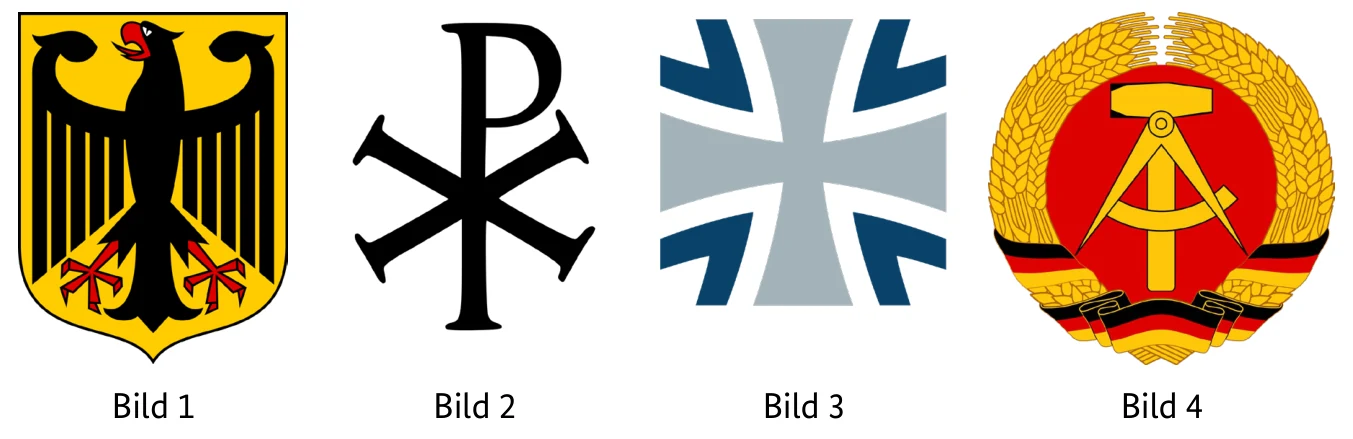
- Bild 1 · Picture 1
- Bild 2 · Picture 2
- Bild 3 · Picture 3
- Bild 4 · Picture 4
Erklärung: Das DDR-Wappen zeigte Hammer und Zirkel in einem Ährenkranz. Das ist Bild 4.
The GDR coat of arms showed a hammer and compass inside a wreath of grain. That is picture 4.
26. Was ereignete sich am 17. Juni 1953 in der DDR?
What happened in the GDR on 17 June 1953?
- der feierliche Beitritt zum Warschauer Pakt · the ceremonial accession to the Warsaw Pact
- landesweite Streiks und ein Volksaufstand · nationwide strikes and a popular uprising
- der 1. SED-Parteitag · the 1st SED party congress
- der erste Besuch Fidel Castros · Fidel Castro's first visit
Erklärung: Am 17. Juni 1953 streikten und protestierten Menschen in der ganzen DDR. Sowjetische Panzer schlugen den Aufstand nieder.
On 17 June 1953 people went on strike and protested across the GDR. Soviet tanks crushed the uprising.
27. Welcher Politiker steht für die "Ostverträge"?
Which politician is associated with the "Eastern Treaties" (Ostverträge)?
- Helmut Kohl · Helmut Kohl
- Willy Brandt · Willy Brandt
- Michail Gorbatschow · Mikhail Gorbachev
- Ludwig Erhard · Ludwig Erhard
Erklärung: Bundeskanzler Willy Brandt schloss ab 1970 die Ostverträge mit der Sowjetunion, Polen und der Tschechoslowakei (Entspannungspolitik).
From 1970 Chancellor Willy Brandt concluded the Eastern Treaties with the Soviet Union, Poland and Czechoslovakia (détente policy).
28. Wie heißt Deutschland mit vollem Namen?
What is Germany's full name?
- Bundesstaat Deutschland · Federal State of Germany
- Bundesländer Deutschland · Federal States of Germany
- Bundesrepublik Deutschland · Federal Republic of Germany
- Bundesbezirk Deutschland · Federal District of Germany
Erklärung: Der volle Name Deutschlands ist Bundesrepublik Deutschland.
Germany's full name is the Federal Republic of Germany.
29. Wie viele Einwohner hat Deutschland?
How many inhabitants does Germany have?
- 70 Millionen · 70 million
- 78 Millionen · 78 million
- 84 Millionen · 84 million
- 90 Millionen · 90 million
Erklärung: In Deutschland leben rund 84 Millionen Menschen. Diese Zahl ändert sich mit der Bevölkerung.
About 84 million people live in Germany. This figure changes as the population changes.
30. Welche Farben hat die deutsche Flagge?
What are the colours of the German flag?
- schwarz-rot-gold · black-red-gold
- rot-weiß-schwarz · red-white-black
- schwarz-rot-grün · black-red-green
- schwarz-gelb-rot · black-yellow-red
Erklärung: Die Bundesflagge ist schwarz-rot-gold.
The federal flag is black, red and gold.
31. Wer wird als "Kanzler der Deutschen Einheit" bezeichnet?
Who is called the "Chancellor of German Unity"?
- Gerhard Schröder · Gerhard Schröder
- Helmut Kohl · Helmut Kohl
- Konrad Adenauer · Konrad Adenauer
- Helmut Schmidt · Helmut Schmidt
Erklärung: Helmut Kohl war 1990 Bundeskanzler, als Deutschland wiedervereinigt wurde. Deshalb nennt man ihn „Kanzler der Deutschen Einheit“.
Helmut Kohl was Chancellor in 1990 when Germany was reunified, so he is called the "Chancellor of German Unity".
32. Welches Symbol ist im Plenarsaal des Deutschen Bundestages zu sehen?
Which symbol can be seen in the plenary chamber of the German Bundestag?
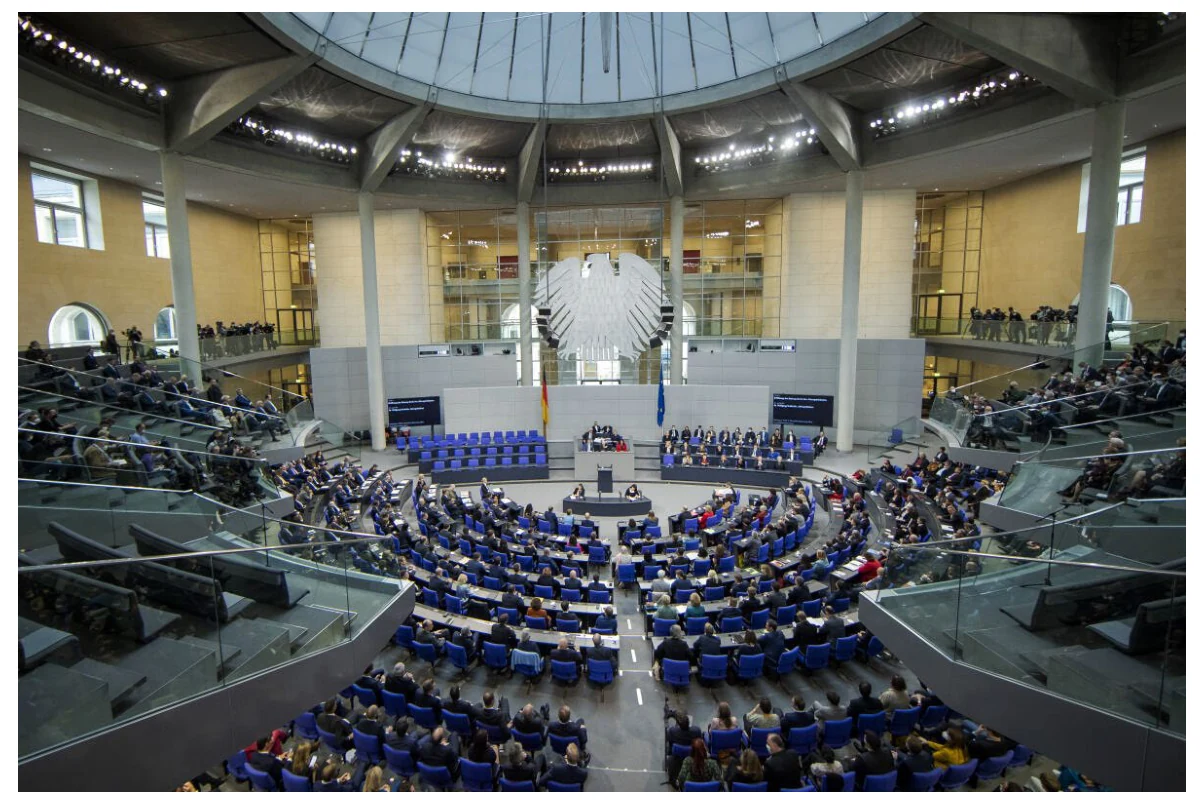
© Deutscher Bundestag/Janine Schmitz
- der Bundesadler · the Federal Eagle
- die Fahne der Stadt Berlin · the flag of the city of Berlin
- der Reichsadler · the Imperial Eagle
- die Reichskrone · the Imperial Crown
Erklärung: Im Plenarsaal des Bundestages hängt ein großer Bundesadler an der Wand.
A large federal eagle hangs on the wall of the Bundestag's plenary chamber.
33. In welchem Zeitraum gab es die Deutsche Demokratische Republik (DDR)?
During which period did the German Democratic Republic (GDR) exist?
- 1919 bis 1927 · 1919 to 1927
- 1933 bis 1945 · 1933 to 1945
- 1945 bis 1961 · 1945 to 1961
- 1949 bis 1990 · 1949 to 1990
Erklärung: Die DDR bestand vom 7. Oktober 1949 bis zum 3. Oktober 1990.
The GDR existed from 7 October 1949 to 3 October 1990.
34. Wie viele Bundesländer kamen bei der Wiedervereinigung 1990 zur Bundesrepublik Deutschland hinzu?
How many federal states joined the Federal Republic of Germany at reunification in 1990?
- 4 · 4
- 5 · 5
- 6 · 6
- 7 · 7
Erklärung: 1990 kamen 5 neue Länder dazu: Brandenburg, Mecklenburg-Vorpommern, Sachsen, Sachsen-Anhalt und Thüringen.
In 1990 5 new states joined: Brandenburg, Mecklenburg-Western Pomerania, Saxony, Saxony-Anhalt and Thuringia.
35. Die Bundesrepublik Deutschland hat die Grenzen von heute seit …
The Federal Republic of Germany has had its present borders since …
- 1933 · 1933
- 1949 · 1949
- 1971 · 1971
- 1990 · 1990
Erklärung: Die heutigen Grenzen gelten seit der Wiedervereinigung 1990 (Zwei-plus-Vier-Vertrag).
Today's borders have applied since reunification in 1990 (Two Plus Four Treaty).
36. Der 27. Januar ist in Deutschland ein offizieller Gedenktag. Woran erinnert dieser Tag?
27 January is an official day of remembrance in Germany. What does this day commemorate?
- an das Ende des Zweiten Weltkrieges · the end of the Second World War
- an die Verabschiedung des Grundgesetzes · the adoption of the Basic Law
- an die Wiedervereinigung Deutschlands · the reunification of Germany
- an die Opfer des Nationalsozialismus (Tag der Befreiung des Vernichtungslagers Auschwitz) · the victims of National Socialism (day of the liberation of the Auschwitz extermination camp)
Erklärung: Am 27. Januar 1945 wurde das Vernichtungslager Auschwitz befreit. Seit 1996 ist der Tag Gedenktag für die Opfer des Nationalsozialismus.
On 27 January 1945 the Auschwitz extermination camp was liberated. Since 1996 the day has been the day of remembrance for the victims of National Socialism.